Is Google a Monopoly? The Genius Lawsuit, the Courts, and AI Overviews (2027 Update)
I first wrote this piece for Planet Content in December 2019. Back then my verdict was that Google wasn’t technically a monopoly but acted like one. Since then, US courts have ruled on that exact question twice. I’ve rewritten the article for 2027 and kept the original cases, with what happened to each.
Marketers have always had a love-hate relationship with Google. For two decades it has been the default answer to “where do I find out?” If it vanished tomorrow, most people would feel lost, and getting used to another search engine would take time.
In 2019 the question “Is Google a monopoly?” was a debate between marketers. In August 2024 it became a legal fact. A US federal judge ruled that “Google is a monopolist, and it has acted as one to maintain its monopoly.”
Let’s look at how we got here, what the courts decided, and what it means for anyone who depends on Google traffic.
Contents
- The ubiquity trap
- Is Google a monopoly?
- The courts answer: US v. Google
- Battling the giant: from featured snippets to AI Overviews
- Genius vs. Google
- Wikipedia vs. Google
- LiveVideo vs. Google
- CelebrityNetWorth.com vs. Google
- Other cases
- What these cases mean for marketers
The Ubiquity Trap
Think of it like Windows. Unless you’ve made a point of choosing something else, you use it. Most people don’t think about search engine market share. Google works, it’s familiar, and it’s the default almost everywhere.
That default status is the whole story. As the courts later found, Google paid billions of dollars a year to stay the default search engine in Safari, on Android phones, and in browsers like Firefox. Most users never change a default, so being the default means being the habit.
And inside Google’s domain, you follow Google’s rules. Shortcuts and loopholes are labelled black-hat SEO, and the penalty is falling down the results or disappearing entirely. Businesses have little choice but to play by a standard that Google alone sets and enforces.
Is Google a Monopoly?
In 2019 I wrote that Google was “technically, no” a monopoly by the textbook definition, but that it checked most of the boxes: barriers to entry, price-making power and economies of scale.
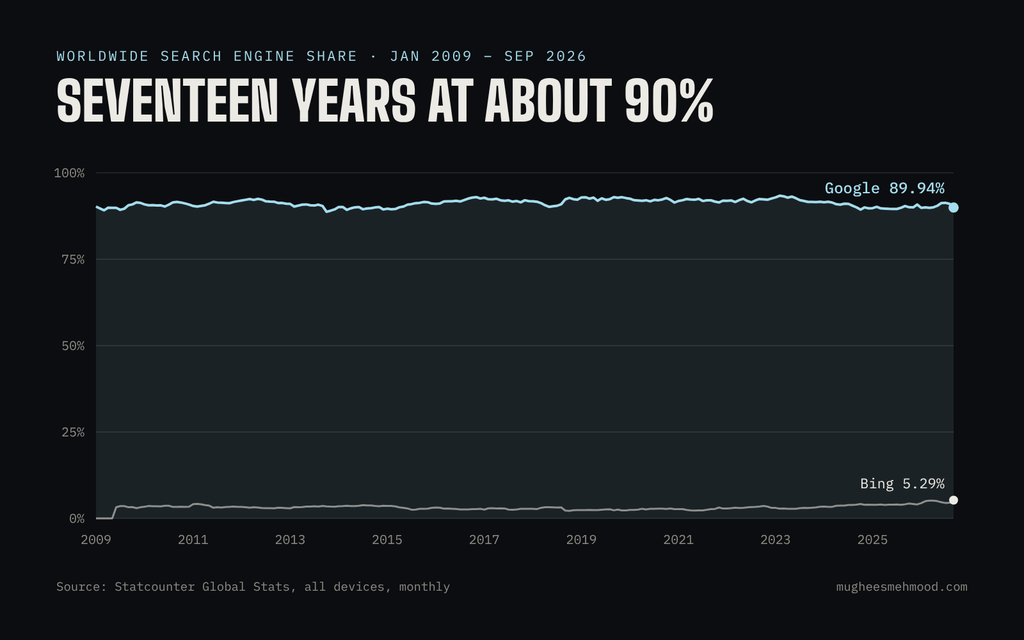
The numbers haven’t moved much. According to Statcounter, Google held 89.94% of worldwide search in September 2026. Bing held 5.29%, and every other engine was below 1.5%.
What other search engines are trying to do
With that kind of share, nobody competes with Google head-on. Each rival carves out a niche:
- Bing is the default on Windows and in Microsoft Edge, and powers Copilot’s web answers.
- Yahoo runs on its legacy, with Bing’s results underneath.
- Baidu dominates in China with results built for Chinese users.
- Yandex is built for Russian-language users.
- DuckDuckGo sells privacy.
The real challengers after 2022 weren’t search engines at all. ChatGPT, Gemini, Claude and Perplexity started answering questions that used to go to Google, and Google responded by putting AI answers at the top of its own results.
The Courts Answer: US v. Google
Here’s the part that didn’t exist when I wrote the original article.
The search case
The US Department of Justice and a group of states sued Google in October 2020. On August 5, 2024, Judge Amit Mehta ruled that Google had illegally maintained its monopoly in general search and search text advertising, mainly through exclusive default deals with Apple, Samsung, browser makers and phone carriers. Court records showed Google paid Apple around $20 billion in 2022 alone to be Safari’s default.
On September 2, 2025, Judge Mehta issued his remedies. He did not order Google to sell Chrome or Android. Instead:
- Google can keep paying for default placement, but the deals can’t be exclusive.
- Partners must be free to promote rival search engines and AI products.
- Default agreements are limited to one year at a time.
- Google must share some search index and interaction data with qualified competitors.
Google appealed in May 2026, asking the DC Circuit to reverse the ruling in its entirety.
The ad tech case
A second DOJ case targeted Google’s advertising technology. In April 2025, Judge Leonie Brinkema ruled that Google had illegally monopolized two markets: publisher ad servers and ad exchanges. On September 2, 2026, she declined to force a sale of Google’s AdX exchange and ordered behavioural changes instead, including new auction rules and sharing real-time bid data with rival ad servers.
The app store case
In Epic Games v. Google, a jury found in December 2023 that Google’s Play Store was an illegal monopoly. The Ninth Circuit upheld the verdict in July 2025, the Supreme Court refused to pause the required changes in October 2025, and the companies announced a settlement in November 2025 that lets rival app stores be distributed through Google Play.
Europe
The European Union got there first. The €2.42 billion Google Shopping fine from 2017, which I mentioned in the original article, was upheld by the EU’s top court in September 2024. In September 2025 the European Commission added a €2.95 billion fine over Google’s adtech practices.
So, is Google a monopoly? In the United States, legally, yes, in general search and in parts of ad tech. The remaining fight is over what to do about it.
Battling the Giant: From Featured Snippets to AI Overviews
Google is still a gold mine for businesses. Compared with TV, radio or print, it’s one of the cheapest ways to reach people who are actively looking for what you sell. Organic search and paid search together built thousands of businesses, including the agencies I’ve worked for.
But Google isn’t doing this for the greater good. It earns money from businesses trying to rank, and it controls how much of the results page goes to organic links.
In 2019 the clearest example was the featured snippet: a box at the top of the results that answers your question directly, using text taken from a website. Google describes how featured snippets work as a way to help people find answers faster.
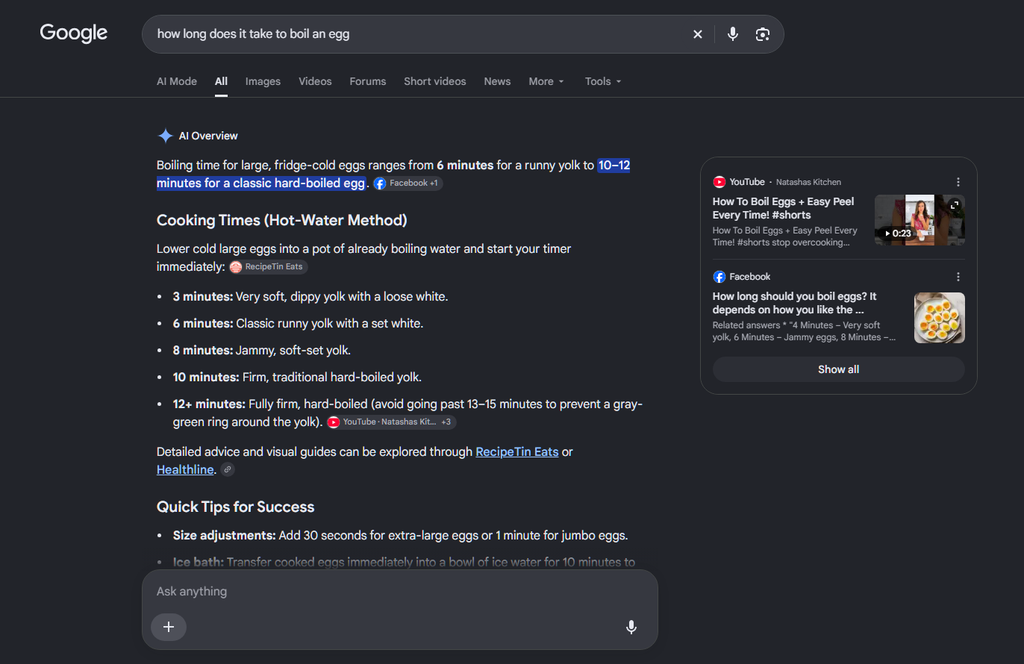
The problem is simple. If the answer is on the results page, people don’t click. The website that wrote the answer loses the visit.
2024 onwards: AI Overviews
In May 2024 Google rolled out AI Overviews in the US: AI-written summaries that sit above the organic results and draw on several websites at once. In 2025 it added AI Mode, a chat-style search experience.
AI Overviews are featured snippets at a much larger scale. A Pew Research Center study in July 2025 found that Google users clicked a link in 8% of visits when an AI summary appeared, compared with 15% when it didn’t.
Publishers pushed back. Penske Media, owner of Rolling Stone and Billboard, sued Google in September 2025, and Chegg joined the suit. On October 1, 2026, Judge Mehta dismissed it, writing that the expectation of search traffic “is simply how a general search engine works.” The dismissal was without prejudice, so the publishers can refile.
The two schools of thought, then and now
In 2019 marketers split into two camps:
- Optimise for featured snippets so your site is the one quoted at the top.
- Don’t chase snippets, because real buyers scroll down and click anyway.
In 2027 the same split exists for AI Overviews and AI assistants. Most teams now do both: they structure content to be quoted and cited, and they build reasons to click that a summary can’t replace, like tools, original data, templates and opinions.
The rest of this article covers the cases that first exposed the problem.
Genius vs. Google
Genius is an online library of song lyrics and music knowledge. Lyrics licensing used to be a grey area, and most lyrics sites posted lyrics without paying publishers. Genius signed licensing agreements with music publishers in May 2014.
A little background
The feud started in 2013, when Genius was still Rap Genius. When Justin Bieber released a new album that year, Rap Genius offered bloggers an “affiliate program”: it would tweet their posts if they linked to Rap Genius lyrics pages. Blogger John Marbach exposed the scheme, Google treated it as a link scheme, and Rap Genius dropped to the sixth page of results. After cleaning up, it was back on the first page within about ten days.
Post-2013: when accuracy became licensing
By 2014 most lyrics sites had licensed their content. As SEO consultant AJ Kohn pointed out at the time, the problem started when Google began treating “licensed” and “accurate” as the same thing.
Google’s Search Quality Rater Guidelines, which human raters use to evaluate search results, were updated in 2015. Raters were told to give Google’s own lyrics box the highest rating, “Fully Meets,” while lyrics websites typically got “Moderately Meets.”
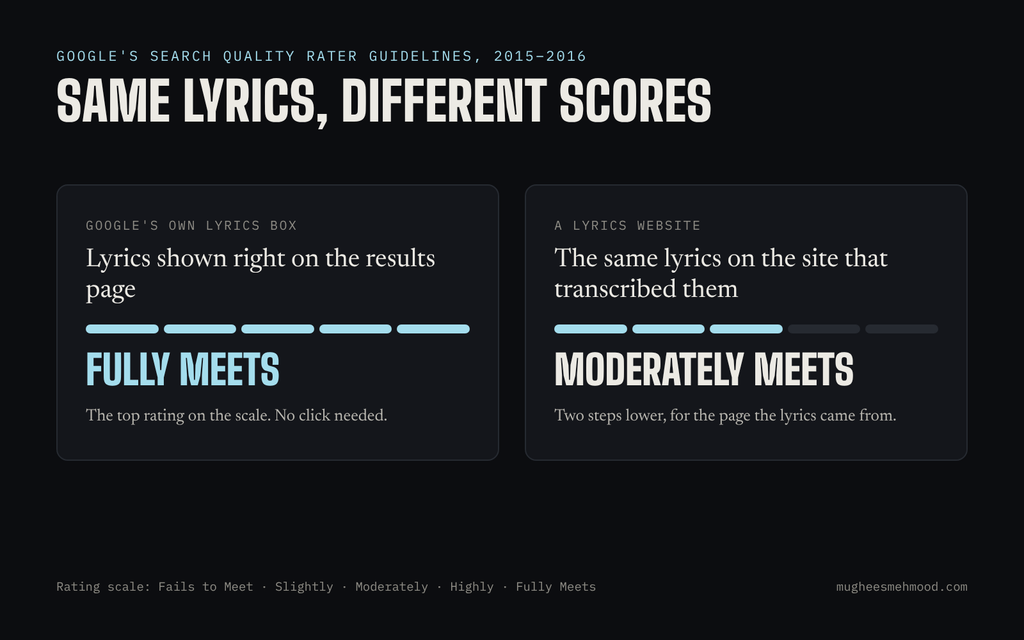
In other words, the same lyrics were rated as better when Google showed them than when the website that transcribed them did.
The sting
From 2016, Genius noticed its traffic falling and suspected Google’s lyrics box was showing its transcriptions. The first clue was Desiigner’s “Panda”, a song with unusual lyrics that Google displayed exactly as Genius had transcribed them.
To prove it, Genius watermarked its lyrics. It alternated between straight and curly apostrophes so that, read as Morse code, they spelled out “red handed.” Then it waited.
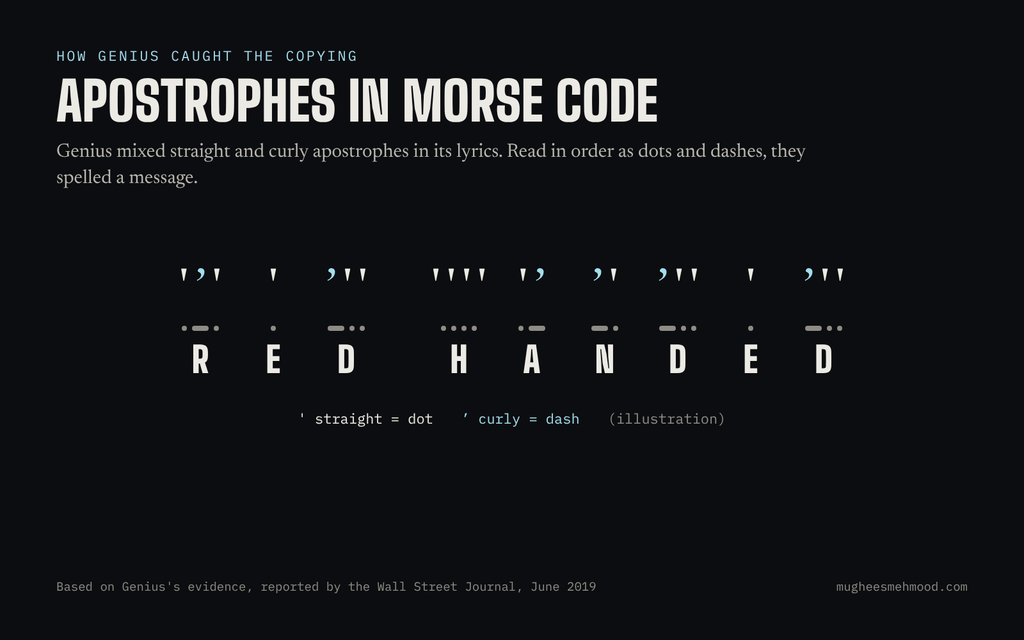
Genius said it found more than 100 songs where Google’s lyrics box contained its watermark. The story only took off when the Wall Street Journal reported it in June 2019. Google said its lyrics came from licensed third-party providers, mainly LyricFind, and promised to investigate. Genius said it had warned Google as early as 2017.
How it ended
Genius sued Google and LyricFind in December 2019, seeking at least $50 million. It didn’t win:
- A federal judge dismissed the case in 2020, ruling that Genius’s claims were really copyright claims. Genius doesn’t own the copyright in the lyrics, the music publishers do.
- The Second Circuit upheld the dismissal in 2022.
- In June 2023 the Supreme Court declined to hear the case, ending it.
Genius proved the copying but couldn’t turn the proof into a legal win, because the thing that was copied wasn’t legally its own. That lesson matters even more in the AI era: proving your content was used and proving you’re owed something are two different fights.
Wikipedia vs. Google
Wikipedia was one of the first big casualties of answers on the results page. Before Google’s Knowledge Graph and featured snippets, Wikipedia sat at the top of countless searches. In 2015 Wikipedia confirmed it was steadily losing Google traffic: people got the answer from the panel and never clicked through.
The irony is that Wikipedia is the source behind much of that panel. Google’s knowledge panels quote Wikipedia constantly.
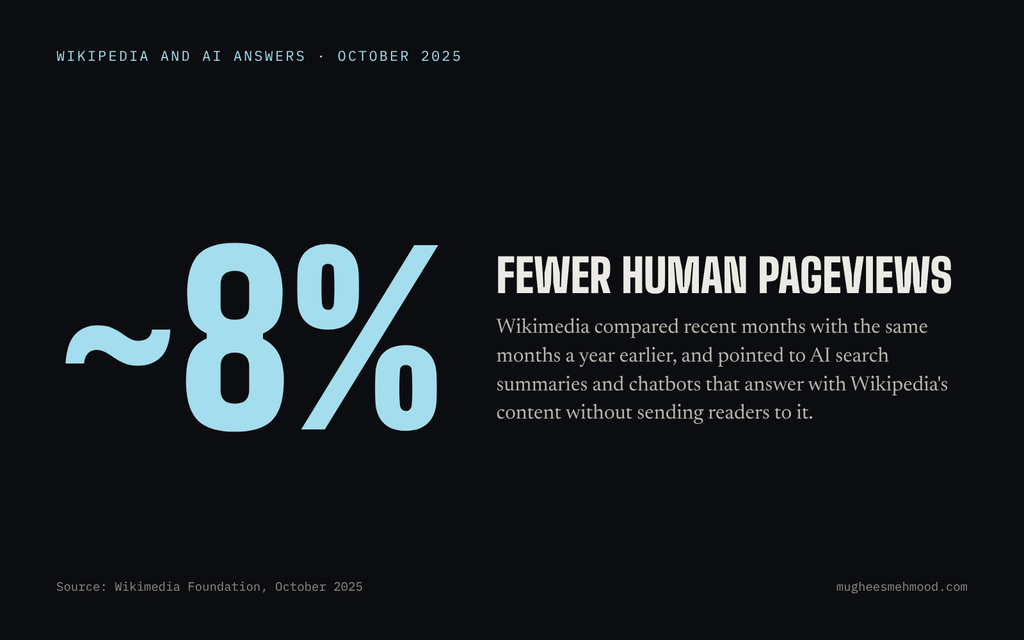
The pattern repeated with AI. In October 2025, the Wikimedia Foundation reported that human pageviews had fallen around 8% year on year, and pointed to AI search summaries and chatbots that answer questions using Wikipedia’s content without sending readers to it.
LiveVideo vs. Google
LiveVideo was a video platform launched in 2006 by Trent Lapinski with Brad Greenspan and Toan Nguyen of Myspace, positioned as a direct competitor to YouTube. In a 2019 post, Lapinski alleged that Google paid LiveVideo’s top creators to move to YouTube, offering as much as $20,000, and that LiveVideo’s pages then dropped out of Google’s results.
LiveVideo shut down, and the story only came out 13 years later. These are allegations from one founder, not court findings, but they fit a pattern the courts later recognised: Google using its position in one market to protect another.
YouTube, of course, became the world’s second most visited website.
CelebrityNetWorth.com vs. Google
Celebrity Net Worth was built by Brian Warner, a former finance student who couldn’t find Larry David’s net worth anywhere online. The site estimated celebrity wealth from property records, salaries and deals, and grew enough to support a dozen staff.
In 2014 Google asked Warner for access to his database to power its answer boxes. He said no. By 2016 Google was showing his figures in featured snippets anyway. Warner tested it by adding fake entries, and the fake figures appeared in Google too. Sometimes the snippet credited sites that had cited Celebrity Net Worth instead of Warner’s own site.
By 2017 his traffic had fallen 65% and he’d laid off half his staff. After his story was published, Google reduced net worth snippets for less famous people, and some traffic came back.
The same question now applies to every AI answer: when the answer comes from your data, who gets the credit, and who gets the visit?
Other Cases
Google favours its own services
In 2017 the European Commission fined Google €2.42 billion for promoting its own comparison shopping service above rivals. The EU’s top court upheld the fine in 2024. In 2019 a Wall Street Journal investigation reported that Google intervened in its search results more than it admitted publicly.
Today the same concern applies to AI Overviews and AI Mode, which keep users on Google’s own pages, and to Google’s placement of its own products like Google Flights, Google Hotels and YouTube.
Private blog networks (PBNs)
In the original article I argued that Google penalises private blog networks partly because they threaten its ad revenue. Looking back, that was more opinion than evidence. The more practical point in 2027 is that Google has widened its spam policies far beyond PBNs. Its March 2024 core update added policies against scaled content abuse, site reputation abuse and expired domain abuse. Shortcuts that work for a few months now carry far more risk than they did in 2019.
What These Cases Mean for Marketers
The lessons from 2019 still hold, and the courts have added new ones:
- Google is big, but not untouchable. It took the Wall Street Journal to move Google on Genius. It took the Department of Justice to change its default deals.
- Proof isn’t the same as a claim. Genius proved the copying and still lost, because it didn’t own the lyrics. Know what you own before you fight over it.
- Public pressure works faster than lawsuits. Media coverage changed Google’s behaviour within weeks. Court cases took years.
- Don’t build on one channel. Every business in this article depended on Google traffic. Build email lists, communities, direct traffic and brand demand that no algorithm update can take away.
- Optimise to be cited, and to be clicked. In an AI-answer world, structure content so it gets quoted, and offer something a summary can’t replace.
Final Verdict
In 2019 I wrote that Google wasn’t a monopoly by the dictionary definition, but definitely acted like one.
In 2027 the dictionary doesn’t matter. A US federal court has ruled that Google is a monopolist in general search, another has ruled the same about parts of its ad tech business, and a jury found the same about its app store. The remedies are behavioural, not a breakup, and Google is appealing.
The bigger shift is the one nobody in court predicted. The strongest pressure on Google’s search business now comes from AI assistants, and Google’s answer has been to put its own AI at the top of the page. For marketers that’s both the risk and the opportunity: the businesses that do best are the ones a summary can’t replace.